Tuesday, January 15, 2019

HIPAA Privacy and Minors

How does the HIPAA Privacy Rule apply to minors?

Patient privacy is just as important for children under the age of 18 as it is for adults. However, health care providers must follow certain stipulations under the HIPAA Privacy rule when handling the protected health information of these individuals.
How does the HIPAA Privacy Rule apply to minors?
Answer: Before a child reaches the age of majority, which is 18 years old in most states, he cannot legally exercise his rights granted by the HIPAA Privacy Rule. Minors’ parents or guardians act as personal representatives under special patient considerations. The most important thing to note is that the Privacy Rule grants parents access to their children’s medical records. As such, a health care provider handing over sensitive information about a patient under the age of 18 to his parent would not be in violation of the law.
Generally, covered entities should treat parents - and all personal representatives - as they would the individual whom the person represents. The guardians of minors have the same rights as the patient. As such, beyond granting access to the patient’s medical record, health care providers must also let these representatives know about the release of PHI, authorize disclosures and make decisions on the patient’s behalf.
There are certain circumstances in which a child’s parent is not his personal representative, and release of information to the parent in this situation would constitute a violation. According to the U.S. Department of Health and Human Services, a doctor should not consider a parent the personal representative when:
  • A parent agrees that the minor and health care provider may have a confidential relationship.
  • Parental consent for care is not required under law.
  • A court provides direction for care or appoints an individual to care for the minor.
Additionally, as with all personal representatives, a doctor can use his discretion in determining whether passing on information to a parent would be beneficial to the patient. If the health care provider suspects the guardian neglects the child or subjects him to abuse, for example, the physician may refuse to continue treating the parent as a personal representative.

Source: https://www.hipaahelpcenter.com/privacy/how-does-hipaa-privacy-rule-apply-to-minors

Tuesday, December 11, 2018

John Bowlby Attachment Theory

John Bowlby Attachment Theory

Sponsored
JOHN BOWLBY:
  • British Child Psychiatrist & Psychoanalyst.
  • First attachment theorist who described attachment as a “lasting psychological connectedness b/w humans”. He gave the famous theory known as “John Bowlby Attachment Theory”, which is discussed below.
  • Believed that the earliest bonds formed by children with their caregivers have a tremendous impact that continues throughout life.
  • According to him,the attachment tends to keep the infant close to the mother ultimately improving the child’s chances of survival.

☆ What is Attachment?

A strong & affectionate tie we have, with special people in our lives gives us pleasure whenever we interact with them and provides a sense of comfort in times of stress.
Through psychoanalytic and behaviorist perspective, feeding can be seen as a central context, where the care-giver and babies develop attachment.
bowlby_attachment_theory

☆ Attachment Theory

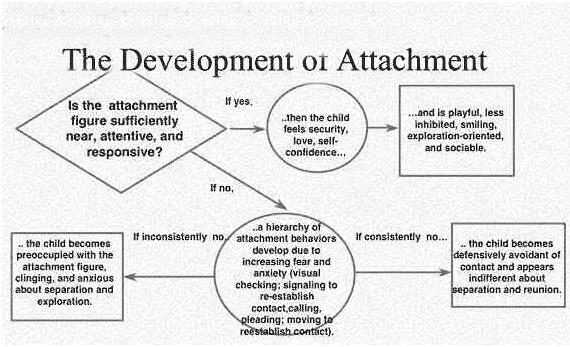
First relationship of a child is a love relationship that will have profound everlasting influence on an individual’s mental development.
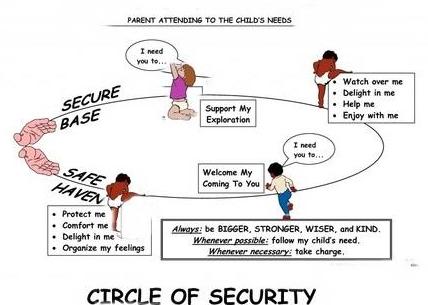
  • Mothers (Caregivers) who are available and responsive, establish a sense of security in the infants such that they know that the caregiver is dependable, creating a secure base for the child to explore the world.
  • Attachments must build a good foundation for being able to form other secure relationships.

☆ Components of Attachment

  • Safe Haven: A child can return to the caregiver for comfort and soothing whenever the child feels threatened or afraid.
  • Secure Base: A secure and dependable base is provided by the caretaker for the child to explore the world.
  • Proximity Maintenance: The child strives to stay around the caregiver, which provides safety.
  • Separation Distress: The child will become upset and distressed during the separation from the caretaker.
components of attachment

☆ BOWLBY’S ETHOLOGICAL THEORY

  • Ethological Theory of Attachment recognizes infant’s emotional tie to the caregiver as an evolved response that promotes survival.
  • John Bowlby induced this idea for infant-caregiver bond.
  • He retained the psychoanalyst idea that the quality of attachment with the caregiver has profound implication for child’s security and capacity to form trustworthy relationship. He said ‘FEEDING IS NOT THE BASIS FOR ATTACHMENT’.
  • The central theme of this theory is that the mothers who are available and responsive to their infant’s needs create a sense of security among their children. Knowing the dependability of the caretaker on them creates a secure base for the child to then explore the world.

Please note that the ages below are just in one of our groupings.  However, attachments occur at ALL ages but the first attachments determine how the successive ones go!  So when you are doing your attachments, you must show how they connected to your first attachment.


 ☆ 4 PHASES OF ATTACHMENT DEVELOPMENT

Babies are born with behaviors like crying, babbling and laughing to gain adult attention & on the other side, adults are biologically programmed to respond to their signals.

He viewed the first 3 years as the most sensitive period for the attachment.
According to Bowlby, following are the 4 phases of attachment:
  • Pre attachment Phase (Birth – 6 Weeks)
  • “Attachment in Making” Phase ( 6 Weeks – 6 to 8 Months)
  • “Clear Cut” Attachment Phase ( 6-8 Months to 18 Months-2 Years)
  • Formation Of Reciprocal Relationship (18 Months – 2 Years and on)
1.  PRE ATTACHMENT PHASE (BIRTH -6 WEEKS)
  • The innate signals attract the caregiver (grasping, gazing, crying, smiling while looking into the adult’s eyes).
  • When the baby responds in a positive manner ,the caregivers remain close by.
  • The infants get encouraged by the adults to remain close as it comforts them.
  • Babies recognize the mother’s fragrance, voice and face.
  • They are not yet attached to the mother and don’t mind being left with unfamiliar adults as they have no fear of strangers.
2. “ATTACHMENT IN MAKING” PHASE (6 Weeks – 6 to 8 Months)
  • Infants responds differently to familiar caregivers than to strangers. The baby would smile more to the mother and babble to her and will become quiet more quickly, whenever picked by the mother.
  • The infant learns that his/her actions affect the behavior of those around.
  • They tend to develop a “Sense of Trust” where they expect the response of caregiver, when signalled.
  • They do not protest when they get separated from the caregiver.
3. “CLEAR CUT” ATTACHMENT PHASE (6-8 Months to 18 Months -2 Years)
  • The attachment to familiar caregiver becomes evident.
  • Babies show “separation anxiety”, and get upset when an adult on whom they rely, leaves them.
  • This anxiety increases b/w 6 -15 months, and its occurrence depends on the temperament and the context of the infant and the behavior of the adult.
  • The child would show signs of distress, in case the mother leaves, but with the supportive and sensitive nature of the caretaker, this anxiety could be reduced.
4. FORMATION OF RECIPROCAL RELATIONSHIP (18 Months – 2 Years and on)
With rapid growth in representation and language by 2 years, the toddler is able to understand few factors that influence parent’s coming and going, and can predict their return. Thus leading to a decline in separation protests.
  • The child can negotiate with the caregiver to alter his/her goals via requests and persuasions.
  • Child depends less on the caregiver along with the age.
SOURCE: https://studiousguy.com/john-bowlby-attachment-theory/

Monday, October 8, 2018

Cuteness Article

How cute things hijack our brains and drive behaviour

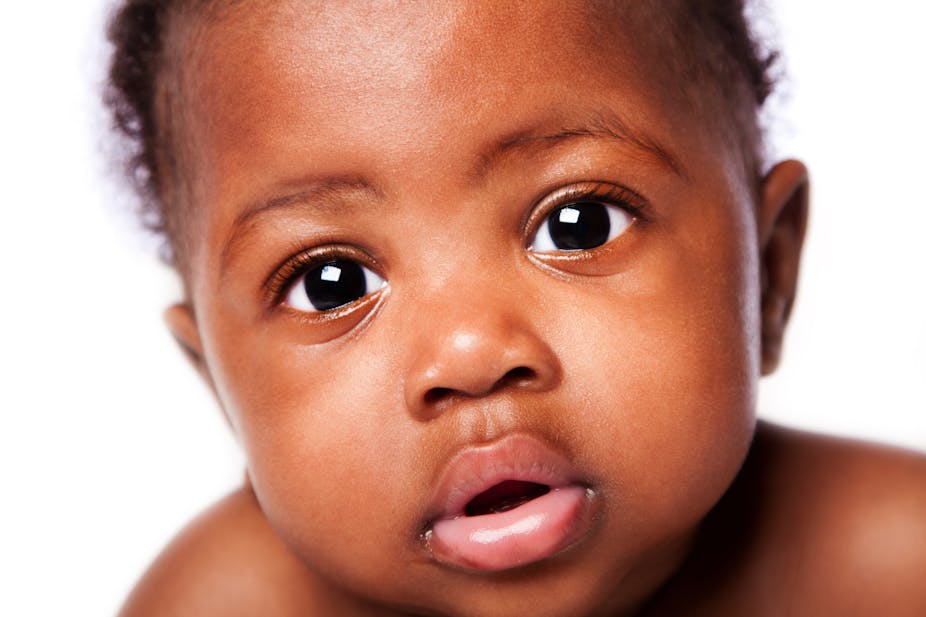
Awwwwww. Paul Hakimata Photography
What is the cutest thing you have ever seen? Chances are it involves a baby, a puppy or another adorable animal. And chances are it is forever imprinted on your mind. But what exactly is this powerful attractive force and how is it expressed in the brain?
Together with our colleagues Marc Bornstein from the National Institute of Child Health and Human Development and Catherine Alexander from the University of Oxford, we have reviewed the existing research on the topic and discovered that cuteness is more than something purely visual. It works by involving all the senses and strongly attracting our attention by sparking rapid brain activity. In fact, cuteness may be one of the strongest forces that shape our behaviour – potentially making us more compassionate.
Babies are designed to jump to the front of the queue – our brain-processing queue, that is. They get ahead of everything else going on in our minds, which makes them difficult to ignore. They also grab our attention even before we have time to recognise that they are babies. They do it by being cute.
Babies not only look cute, with their big eyes, chubby cheeks and button noses, their infectious laughs and captivating scent also make them sound and smell cute. Their soft skin and chubby limbs may even make them feel cute. Together, these aesthetic qualities act as a crucial mechanism that enables babies to attract us through all our senses. Babies need constant attention and care to survive, and cuteness is one of the main ways they get it.
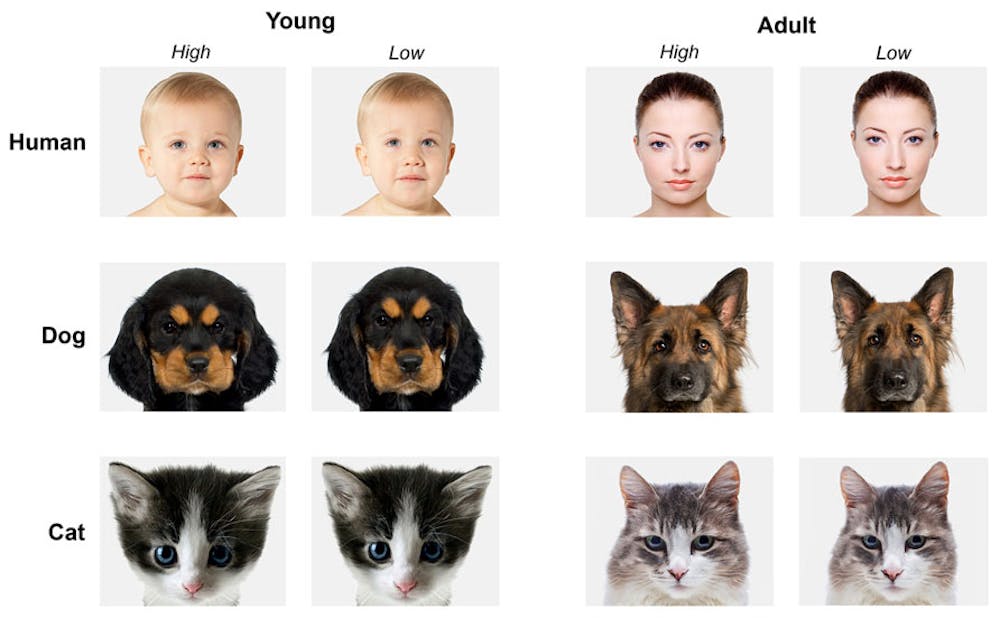
We find infants and baby animals (left) cuter than adults (right). Cuteness can be further manipulated by exaggerating the roundness of the face, high forehead and big eyes, small nose, and mouth (high vs low). Frontiers/Getty images, Author provided
This nurturing instinct could even be driving our wider perception of cuteness – research has shown that we typically feel affection for animals with juvenile features. Dogs, for instance, have been bred to have similar features to babies, with big eyes, bulging craniums and recessed chins. They are also soft to touch. Whether we want it or not, we may also feel a certain affection for adults and even inanimate objects with infant-like features such as dolls, teddies and even miniature products.

Cuteness on the brain

Cuteness may help to facilitate well-being and complex social relationships by activating brain networks associated with emotion and pleasure and triggering empathy and compassion. When we encounter something cute, it ignites fast brain activity in regions such as the orbitofrontal cortex, which are linked to emotion and pleasure. It also attracts our attention in a biased way: babies have privileged access to entering conscious awareness in our brains.
As a result, we like looking at babies and other cute things. Research has shown that people would rather look at cute baby faces than adult faces and that they would rather adopt or give a toy to babies with cuter faces. Studies have also shown that even babies and children prefer cute baby faces and that cuteness affects both men and women, even if they are not parents. Cute babies also spur us to action: research reveals that people will expend extra effort to look longer at cute baby faces.
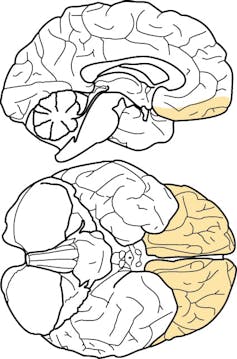
Human orbitofrontal cortex (OFC). The top image shows the OFC on a slice through the middle of the brain, while the bottom image shows the brain seen from below, revealing the OFC covering the part of the brain just over the eyeballs. Morten Kringelbach
Neuroimaging research has shown that in adults, the orbitofrontal cortex becomes active very quickly – 140ms or a seventh of a second – after seeing a baby face. The orbitofrontal cortex is strongly involved in orchestrating our emotions and pleasures, so its rapid activity may partly explain how babies appropriate our attention so quickly and completely.
Cuteness also initiates a response that happens much more slowly. The initial fast attention triggers slower, more sustained processing in large brain networks. This kind of brain activity is associated with complex behaviours involved in the caregiving and bondingthat are the hallmarks of parenting. Caring for a baby calls for a set of skills that take time to acquire and hone, and this slow attainment of expertise changes the caregiver’s brain. This kind of considered behaviour cannot be reduced to the fast, instinctual rapid reaction to cuteness.

Can cuteness make us better people?

Parenting is a good example of how cuteness can trigger slow, sustained brain processing in networks associated with emotion, pleasure and social interactions. Still, as shown by our interest not only in our own infants but in other infants and baby animals, cuteness can help trigger empathy and compassion beyond parenting. Activating this network of brain activity may also enable cuteness to boost moral concern by expanding the boundary around what we regard as worthy of moral consideration. For example, an image of a cute infant or baby animal can help charities nudge us to donate more money.
Double cuteness: Can you resist smiling?
Research on cuteness could also help us to understand how problems in parent-child bonding arise, such as following postpartum depression or an infant being born with a cleft lip and palate. We know these things can disrupt caregiving by changing how people process signals from babies.
Both parental depression and infant cleft lip are associated with developmental difficulties in infants. These conditions are relatively common: post-partum depression affects 10-15% of parents in high-income countries and up to 30% in middle- and low-income countries. Cleft lip affects one in 700 live births in the UK. A better understanding of how we succeed and sometimes fail to receive and interpret baby signals that are crucial for caregiving may help us to develop better treatments for families affected by problems such as these.
We are currently developing early interventions to help increase caregivers’ ability to properly interpret infant signals and provide appropriate responses. We have developed a “baby-social-reward-task” to do this, where participants learn about the temperament of infants through the use of emotional infant vocalisations and faces. Babies that were initially perceived as less cute became more cute through the positive feedback of infant laughter and smiles.

Tuesday, September 8, 2015

Psychology Standards

Psychology Standards


Psychology Content Standards
Area 1 - Foundations and Scientific Inquiry Domain
Standard 1.1 - Understands research methods, measurements, and statistics used in
Psychology.
Standard 1.2 - Understands the history and perspectives of Psychology
Area 2 - Biopsychology Domain
Standard 2.1 - Understands biological bases of Behavior.
Standard 2.2 - Understands the process and perception of sensation and perception.
Standard 2.3 - Understands the levels of consciousness and unconsciousness.
Area 3 - Development and Learning Domain
Standard 3.1 - Understands Life Span development.
Standard 3.2 - Understands the process of learning.
Standard 3.3 - Understands Language development
Area 4 - Sociocultural Context Domain
Standard 4.1 - Understands Social Interactions and how they form behavior.
Standard 4.2 - Understands Sociocultural Diversity and diversity among individuals.
Area 5 - Cognition Domain
Standard 5.1 - Understands encoding, storage, and retrieval of Memory.
Standard 5.2 - Understands basic elements of Thinking.
Standard 5.3 - Understands perspectives, assessment, and issues with Intelligence.
Area 6 - Individual Variations Domain
Standard 6.1 - Understands perspectives on Motivation.
Standard 6.2 - Understands perspectives on emotion, emotional interpretation, and
expression of Emotion
Area 7 - Personality Domain
Standard 7.1 - Understands perspectives on Psychological Disorders and abnormal
behavior.
Area 8 - Applications of Psychology Domain
Standard 8.1 - Understands categories, perspectives and types of Treatments.
Standard 8.2 - Understands legal and ethical issues in treatment.


Professionalism
Standard 1 - Uses appropriate time management and organization.
Standard 2: Presents quality product with focus on interpreting and
communicating information.
Standard 3: Demonstrates ability to work positively and productively with peers
and teachers.

Standard 4: Demonstrates creative and logical approaches to both work process and the final product.

Welcome to Psychology!

Hi!  Welcome to my Psychology classroom!


What do we learn?
In Psychology, we learn about the deep inner recesses of the brain.  We will explore how the outer experience of the world is shaped or perceived by a person's brain and the reverse. 

Uncomfortable Conversations
Part of Psychology is the act of having uncomfortable conversations.
Here are some guidelines for having uncomfortable conversations in the classroom.

  1. Accept the idea that this conversation is making you uncomfortable and
  2. that in that discomfort, you can grow.  
  3. Listen - REALLY listen - hear what the person is saying. 
  4. You don’t have to agree or even understand their viewpoint but empathy is required. 
  5. Don’t assume that by looking at a person you know what their experience is.
  6. Let them explain it in their own words.
  7. Be prepared for emotional reactions either from yourself or the people who are in the conversation.  Remember it’s ok to have emotions.
  8. You are not responsible for people’s emotions or reactions.
  9. Don’t be a fixer.  We are not having conversations to ‘fix’ a person’s life. 
  10. They will have their own process.  
  11. Ask or answer questions openly and without judgement or criticism. 
  12. Be aware of language and tone.  
  13. Experience openness. 
  14. Be open to allow yourself to feel and others to have space. 
  15. A huge part of Psychology is being open to the process of therapy.    
  16. Trust - Know that the conversations that happen in Psychology need to stay in Psychology. 


How do we learn in here?
In Psychology, we are here to prep for life by learning more about ourselves and the people around us. It is our goal to set a solid foundation of both skills and material for entry into college or the workplace.  Psychology tells the story of how we are formed as humans mentally.
1.  Daily Journals and Articles - Be prepared to record your deepest thoughts.  Psychology is about the human brain, experience, emotions, and human development.  Psychologists use their own experience to help them understand and empathize with others.  They also know that the key to a healthy life experience is to understand one's self and their relationships with others.
2.  Projects - Most of the work in this class will be in project form.  Project information will be posted on the Google Classroom site.
3.  Homework - Forms will be sent in the email which will cover information in each of the units, important vocabulary, and basic concepts.
4.  Vocabulary - Psychology is a college level course and taught in a medical capacity so you must be prepared to learn complex vocabulary words and key ideas associated with the field.
5.   Discussion - Class discussions will center around articles and broach sensitive subjects on a variety of life experiences.
6.  Quizzes -  Early Release Wednesday Quizzes are on the vocabulary and topics from the weeks between quizzes.  Any journal topics, project information, or vocabulary from those weeks are study material.  Quizzes are the only part of your grade that may result in direct points on the total points for the class and do not fall under the scoring guide below.

How are we graded?
1.  Standards - every assignment has standards that we must meet.
2.  Scoring - For each standard in an assignment, you receive a score.


Grading Scale:
4 pt. Scale


A
100.00%
3.65%
A-
3.64%
3.50%
B+
3.49%
3.25%
B
3.24%
3.00%
B-
2.99%
2.70%
C+
2.69%
2.30%
C
2.29%
2.00%
C-
1.99%
1.70%
D
1.69%
1.30%
F
1.29%
0.00%

4
Exceptional

In addition to exhibiting level 10 performance, in-depth inferences and applications that go BEYOND what was taught in class and assigned.  
Level 4 learners are very creative and analytical.  
They add details from many sources.
They put all of the details in their own words and add their ideas with those ideas.
Level 4 learners ask questions of all different types (see levels questions).
Level 4 learners spend time explaining their answers.


3
Mastery


No major error or omission regarding any of the information or processes (SIMPLE or COMPLEX, that were taught)

Level 3 learners have some creativity and analysis
They may only rely on a few sources.
They may leave out some details but cover the question.
Level 3 learners have their own words and ideas but may not fully understand or research the questions.
They spend time explaining but may have holes in explanation.


2
Passing

No major errors or omissions regarding SIMPLER details and processes BUT major errors or omission regarding the more complex ideas and processes.

Level 2 learners know the right answers, but they are basic answers and lacking in creativity or analysis.
They answer with details from single source.
They will answer question without explaining or expanding ideas.
Level 2 learners will not always use their own thoughts or words to answer.


1
Striving to Reach Standard

With HELP, a partial knowledge of some of the simpler ideas/details and processes demonstrated.


Level 1 learners are trying to understand questions or ideas.
Level 1 learners may only have basic information in their answers.
They struggle with research and gathering details.
Level 1 learners may not be able to analyze information.

0
Missed Attempt

Even with help, little understanding or skill demonstrated
Level 0 learners frequently don't complete their work.
Level 0 learners are not able to analyze information or just have a few facts.
Level 0 learners did not do the assignment.

If you received a zero on the assignment, it was because more than 1/3 of your information came directly from the sources you used to answer questions or construct the assignment.  This is plagiarism and in a work or higher learning environment can result in severe consequences such as loss of pay or job and/or credit. 


How will I know what my overall grade is?
You are responsible for checking your grade in Skyward.
Your grade is weighted according to the chart below.
Categories and Weighting:

Assessment (Red) = Tests, Complex Products, End of Unit projects,
60%
Assignments (Light Blue) = Daily Journal, Slides, Vocabulary,
30%
Citizenship (White)
10%

Feedback On Your Work

I will return feedback and comments to you on your assignments or through your email.  To improve assignments, please do not remove the feedback.  I will compare your original work to your redone work and need my feedback to help guide me.  If you remove the feedback and scores that I originally gave you, I will likely score you lower or not give you a new score.


What is late work?  Anything that you were supposed to submit on the due date that you failed to submit.

Absences do not excuse you from any due dates.
Excused Absences do NOT excuse you from due dates for any work submitted online.


How do I turn in work to this class?
There are a variety of ways that we will turn in work.

  • The main way that we will turn in work is through Google Classroom.  Our class code is 


  •  jmm2bj

  • The second way to turn in work is through the emails that I send you.  These are called forms and you will fill them out in your email and submit them.  These forms are dated when you submit your answers.  I will not grade anything that is past the due date unless you have an excused absence.
  • The third way is through the folders.  If we have paper products such as posters, I will put out a folder on the day that it is due.  If the assignment does not make it into the folder, it will not be graded.  If you are absent with an excused absence on the day that we turn in a paper assignment, please make sure that you get it directly to me as soon as you return to school.


So what can I do to get a better grade?
Extra Credit:
  • Will be offered as appropriate at teacher discretion
  • Will be designed to supplement student learning
  • Chances are fairly high that any extra rewards opportunities will NOT raise your grade.
  • Extra opportunities will go under the assignment or citizenship categories.
You are better off if you do these strategies;


Always do your Daily Notebook - Make sure that even if you don't finish your notebook during the class period that you go home and finish it for homework.  Before you submit your daily notebook, you should;
        a) Proofread it for grammar and spelling
        b) Check for enough description, examples, or explanations.


On Time Work - Always turn in your work on-time EVEN if it is not finished.  Getting a 1 or 2 on an assignment is better than getting a zero. Even if you get zero on PART of your assignment, it is better because you get a chance to do THE REDO.  Work in class can have multiple parts to it. Make sure that you complete it so that you can get grades in all the standards.


Retakes
Retakes will be offered in the form of test or assessment revisions
  • Students will have the opportunity to correct tests or revise their assessment to receive a higher score.  Chances are high that a student will move up one score level only.  
Students rarely move from a 3 to a 4.
  • Time window for test corrections/revisions will be at teacher discretion - but in most cases 10 school days 
  • Corrections/revisions may be completed as a class assignment or after school.
     
Please save ALL of your emails.  I will not resend you work. However, you can consult with me on what you can do better.  Pay attention to the chart above to help you determine how you can do better not only on your redo but also on future assignments.  


Tips for Good Retakes.
1.  Fix any grammatical errors.
2.  Add more detail, explanation, or examples.
3.  Pay attention to comments.
4.  Don't wait until the last minute to redo something.
5.  Do not delete your original work.  Instead, make the changes inside the original work so that I can compare.  
6.  Follow the retake format that is given to you.

7.  Some retakes will be mandatory.  You will be given instructions.

How will I know that I have work to do?

Daily Work - We will always have work to do in class.   Either through Google Classroom or in your email (or sometimes both) I will deliver assignment instructions to you.  Those assignments will be the ones that we work on in class.

Homework - You will always have homework.  There is more than enough world history to learn!  I will send out vocabulary in Google Docs (make your own copy and you can fill it in!) and other questions (such as video questions) in Google Forms (These forms have boxes to fill in and you will submit them when you are finished.)


Technology is very important in this classroom.  All North Thurston Public Schools policies will be followed while using this valuable resource.  If those policies are not followed, it is at my discretion to remove you from the technology and/or follow the NTPS disciplinary procedures.  Please note that this will have a severe impact on your grade as most of the work that we do in class does not have a hard copy option.


RAMS - Your Behavior
I have high expectations for your behavior.
I expect you to communicate freely and maturely with your teacher and peers.

Sensitive material will be discussed in the classroom.
Since this is a psychology class, some of those sensitive subjects may include personal challenges that your peers are going through, relationships, gender, and sexuality, race and economics.
Please maintain a safe environment for  your peers at ALL times.

In order to maintain a safe environment;
Respect the privacy of everyone around you.  What is said in class must stay in class.
Hold judgement or be cautious about commentary on what students are sharing.  Empathy (the ability to understand other's situations and approach them with compassion) is a key trait to understanding psychology.
Understand that you won't always agree with those around you.

If the behavior clauses above are violated, Mrs. Ward can take disciplinary action in a multitude of way including reporting to the office for harassment and intimidation, discussions with parents about expected code of conduct, or removal from class.

As always we follow all the rules of the school and district including the RAMS standard.
Respect Ourselves and Others
Act Responsibly
Model Safety
Strive For Excellence

Absences and Tardies - In this classroom, all absence reporting is done according to the district and state rules.  If you have an excused absence, you may turn in papers upon your return.  Extra time is not given on assignments unless the time has been long enough that the assignment was given in absence.  In other words, if you are gone on Thursday during the course of an assignment that was given prior to your absence, you are expected to turn the PAPER in when you arrive on Friday EXCEPT in the cases of ONLINE work which is expected to be turned in on deadline.

Tardies - If you receive two tardies in one week, you will receive a lunch detention on the same day as the second tardy.  You will receive a special lunch detention pass and will be reported to detention so that the detention teacher can check you in a report back to me whether you arrived.

Behavior
Lunch detention passes can be given for other discrepancies as well.  Examples of reasons why lunch detentions might be give are;
        a) overuse of cellphones
        b) profane language
        c) inappropriate use of class time
These are just a FEW examples of the reasons why you might receive lunch detention.

Other methods of discipline may include; removal of student from classroom, email home to parent, notes made in Skyward about behavior, or a write-up to the office.

Behaviors that I like to see in the classroom include;
Productive work with all of your peers.
Positive communication with your teacher and peers.
Respect towards yourself and others
Responsible use of all of the technologies around you.
Acceptance and understanding of differences.
Responsibility towards being a good student.
Owning your behaviors and improving on them.